
Apple iPhone 5S design review.
 You all came to know about lot of things about Apple’s new flagship model iPhone 5S ,which was released this month.We are taking the design aspect of the iPhone 5S much closer in this article.While the competitors of the iPhone increased the size of the screen to 4.5 to 5-inch iPhone still be at 4 inch,which makes more pocket friendly than other smartphones in the market.It only weighs 112 grams and only 7.6 millimeters thin.But from now onwards you will get iPhone in “space grey”,”silver” or “gold” colours,but the aluminium body and glass remains as in iPhone 5 except with some aluminium adging that makes iPhone 5S still one of the best designed phones.
Apple still stucked with a “Retina-class” 1,136x640 resolution panel. The power button is still at the top, next to a 3.5mm audio jack. The volume buttons and mute switch are still on the side and the Lightning connector is still found at the bottom .
 The only new physical addition to the iPhone 5S is the TouchID ring made from laser-cut sapphire crystal,built into the home button. The surface of the button directs the image of your finger to a capacitive touch sensor, which reads beneath the outer layers of your skin to get a detailed print. Surrounding the button is a stainless steel ring that detects your finger, wakes the sensor, and improves the signal-to-noise ratio. Software then reads the ridges of your print and finds the match to unlock your phone.

Even though Apple stuck with 8 mega-pixel camera,they added state-of-art sensor which allows the individual pixels to get larger. So iPhone 5s has an all-new 8MP sensor. One that’s 15 percent larger than before, with pixels measuring 1.5 microns. We also increased the aperture to ƒ/2.2. All that adds up to 33 percent greater light sensitivity,which gives you better,brighter images with even more accurate colours.The new True Tone flash(that’s what Apple calls it) which consists of one cool white flash and a second warmer amber LED that automatically adjusts depending on lighting conditions for the best picture. Image stabilization and best shot selection are both automatic. There's also a burst shot mode and 120fps slow motion video recording at 720p, along with the new filters found in iOS7.
Tag :
Apple Phones,
Review
Is Apple's iPhone 5S fingerprint scanner is going to kill password?

Do you all taught that coming of fingerprint scanner in iPhone 5S really going to kill the password? I don’t think so! According to latest news the customers who wish the use Touch ID also have to create a passcode as a backup. If u don’t use iPhone for 48 hours or if you rebooted it then you wanted the passcode(not the fingerprint) to unlock it. This system is to block the hackers to get into the phone.
And you can’t unlock the iPhone with moisture-laden fingers covered in sweat, lotion or other liquids(that includes water).There also problems for persons whose fingers are scarred by accident or surgery. So I really think the passcode will be useful to those persons.

Tag :
Apple Phones,
News
New Sony QX lens pics leaked,which can be attached to Z1 to get 20MP images.


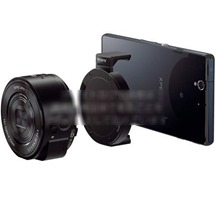 There can no longer be any denying it – Sony is about to announce a self-contained camera inside a lens that attaches to your smartphone. The Sony DSC-QX10 and DSC-QX100 lens camera modules have been spotted a few times, but this is the largest cache of pictures so far.While Sony readies a 20MP shooter for their upcoming (and beautiful) Z1 Honami, they haven’t forgotten the rest of us. Their QX lenses are widely reported to work with just about any device via NFC and/or Bluetooth, and have the ability to work while detached from our phones or tablets. We’ve already seem images.
The DSC-QX10 (everything above this) is the cheaper of the two and will feature 10x optical zoom and an 18MP sensor at f/3.3-5.9. It is rumored to cost $250, and it even comes with a nifty little carrying case. You can see the lens above from every conceivable angle, including the clip mechanism.


 It appears there will be a case (we assume proprietary to a Sony device, probably the Z1) as well the familiar clip-on holder for the lenses. Interestingly enough, the clip-on or case are separate from the lenses, according to these pics. That would be a good choice, and leads us to think there will be more lenses in the future, if these prove to be popular.


If you’re concerned about the blurred portion in the center of the pics, don’t worry — nobody is hiding anything. It seems the helpful tipster plastered the images with some anti-Japanese rhetoric.
Tag :
News,
Sony Mobiles
Samsung Galaxy Note 3 may feature 2.5 GB Ram only.
Earlier today, a tweet from @evleaks revealed two screenshots that supposedly come from the Note 3, one showing an AnTuTu benchmark score, and the other the “About Device” screen. If that’s not enough to peak your interest, the tweet also includes some ‘alleged’ specs that differ a little from most of the rumors out there.
First, let’s talk about the device screenshot. As you can see below, this particular Note 3 is model SM-N9005, and runs Android 4.3 Jelly Bean with build number JSS15J. Not much else here worth taking notice of.
Turning to the second screenshot, we have a benchmark. Honestly, we’re not going to read into this one too much. Sure there are other devices that have achieved much higher results than this, but it is impossible to judge a handset based on a single benchmark.
Even if we had multiple benchmark reports, these scores often mean very little when it comes to real world use.

Okay, so we’ve covered the two images. What about the specs? If @evleaks proves correct, the Samsung Galaxy Note 3 SM-N9005 will feature a 1920 x 1080 display, a 2.3GHz quad-core CPU and 2.5GB RAM.
Keep in mind that the device could actually have 3GB of RAM, but 512MB might be reserved for something else and therefore not counted. There’s also the possibility that the screenshots and/or alleged specs aren’t correct, so speculation is certainly advised.
Samsung will officially announce the Note 3 on Wednesday, September 4th, just ahead of IFA 2013.
Sony Z1 official press images leaked,ahead of it much anticipated launch.
 Long rumored,Sony Z1 (or Honami) official press images have reportedly been leaked.
While images of this nature are often highly doubtful, these appear to be the real deal. They match up with the specs we’ve heard about, as well as previously leaked images. These pics happen to show a bit more detail, and are a touch more glamorous than those we’ve seen before.
If these are images of the final production Z1, we’re smitten. The nearly seamless construction and overall finish are gorgeous, and Sony has hinted the device would be water resistant. Sony always builds high quality devices, and the Z1 — or whatever it’s going to be called — doesn’t seem to be any different.
Tag :
News,
Sony Mobiles
Samsung Galaxy Note 3 expected to launch in IFA 2013.
 The Galaxy Note 3 will represent a natural evolution of the Note series. As is tradition, the Note 3 will inherit a similar upgrade schema to that of the Galaxy S4, barring a few minor, yet notable exceptions. The Galaxy Note 3 will feature the most powerful ARM-based SoC in the world, as well as arguably the most sophisticated and robust GPU, the Adreno 330.
For lovers of mobile technology and aficionados of the large display domain, the Galaxy Note 3 represents the pinnacle of raw mobile power, with its large, brilliant 5.68 inch display. Owners of the Note 2 know how much battery life the behemoth brought to the table from day one. The clumsy among us will testify to its resilience to handle drop after drop. The list goes on and on. And what a conversation starter…
Rumored Galaxy Note 3 release date
History is the greatest indicator of what is to come. Last year, the Galaxy Note 2 was launched at Samsung Unpacked, just before IFA Berlin, on August 29th, 2012. It subsequently went on sale on the streets of Hong Kong on Friday, September 28th. I remember this well because we eagerly and excitedly tracked one down from an official Samsung store, and were able to be among the very first in the world to get one. We proceeded to assault it with a battery of hands-on videos, Versus posts, and a very nice drop test, which, after the horrifying experience with the Galaxy S3, seemed to portend excellent durability for would be Note 2 owners.
Though, this year, rumors in the industry paint a much more accelerated roll out. Let’s not forget that this is a device that has been leaked to death. Case manufacturers partake in their own hyper competitive economy as well, and pay very good amounts of money for leaked product schematics of the next-device-of-the-moment. Have these been leaked for the Galaxy Note 3? Yes they have.

Further, we have purported evidence from Engadget that suggests we should expect the Galaxy Note 3 to on September 16, as seen below. It should be noted that this is likely when Three will receive the first stock, and that it is a report out of the UK, a market that traditionally receives the latest in mobile technology before the US.

Rumored Galaxy Note 3 specs
While nothing here should be considered definitive, it is likely that these are the specs for the upcoming Galaxy Note 3.- Processor: Qualcomm Snapdragon 800
- CPU: Quad-core Krait 400, running at 2.26 GHz
- GPU: Adreno 330
- RAM: 3GB
- OS: Android 4.3.x Jelly Bean?
- Cameras: 13MP rear, 2MP front - no OIS
- Display: 5.68-inch 1920×1080 AMOLED
- Storage: 32GB/64GB iterations (up to 23 GB user-accessible memory on 32GB version), microSD expandability up to 64GB SDXC
- Connectivity: Bluetooth v4.0 with A2DP, NFC, Wi-Fi 802.11 a/b/g/n/ac, dual-band, Wi-Fi Direct, DLNA, Wi-Fi hotspot
- Networks: UMTS HSPA+ 900 (Band VIII), 2100 (Band I) MHz, 850 (Band V), 1900 (Band II), 1700 (Band IV), GSM GPRS/EDGE 850, 900, 1800, 1900 MHz, 4G LTE
- Battery: removable 3200mAh
Tag :
Tablets
New images of Samsung Galaxy Note 12.2 leaked!

A rendering of a tablet claimed to be the Samsung Galaxy Note 12.2 has leaked online.As you can probably figure out, the 12.2 in the product name hints that it has a 12.2-inch display. If true, it would make for an impressive tablet for movie watching, but might make a rather bulky device to take with you on the go. Sources claim that the device will carry model number SM-P900 and is set to be released in the second half of 2013.
The tablet is tipped to be S Pen-enabled and run the Android operating system, as you would expect from anything in the Galaxy line. The rendering shows a big-screen device with a physical home button along with a couple of virtual buttons for other functionality. Perhaps the most interesting part of this rumored tablet comes with the screen resolution.
The tablet is tipped for a resolution of 2560 x 1600. That resolution is typically reserved for massive 30-inch desktop displays. We are taking this with a grain of salt for now considering that it’s a rendering of the device and not an actual photo. However, Samsung has been rumored to be working on a large 12-inch tablet in the past so were not ready to call BS just yet. Perhaps the official announcement for this tablet will come this week during IFA 2013.
Tag :
Tablets
Hello Kitty Butterfly S edition launched by HTC.
HTC officially announced the “limited edition” Hello Kitty Butterfly S today, which is now being showcased on the HTC Taiwan website. According to various Taiwanese media outlets that attended HTC’s launch event, the device will retail for NT$22,900 ($765) — the same price the Butterfly S went on sale for in Taiwan at the end of June.

The Hello Kitty Butterfly S also comes pre-loaded with nine Hello Kitty wallpapers — all the better for those madly in love with the cartoon cat.
The Butterfly S, which was unveiled in mid-June, is a top-tier handset on par with the company’s flagship HTC One that features a 5-inch 1080p display and runs Android Jelly Bean on a quad-core 1.9GHZ Snapdragon 600 processor. It also comes with an UltraPixel Camera, as well as a 2.1-megapixel front-facing wide-angle camera, and should provide plenty of juice from its 3,200 mAh battery.
There has been no word yet on subsequent launches of the Butterfly S in Asia or internationally, though it makes sense that if the Hello Kitty Butterfly S does well, other markets may gladly welcome it — and the cutesy cartoon cat could well help refresh the company’s image.
Tag :
HTC Mobiles,
News
Acer liquid S2 launched!
 Acer has unveiled its latest Android-powered smartphone at IFA 2013. If you’re the sort of early adopter that’s always out to get the latest features first, you’ll want to pay attention to this device. The Liquid S2 can record 4K resolution video with four times the resolution of 1080p.
The downside is you’ll need a display of some sort display supporting 4K resolution to enjoy that video. The smartphone can also shoot still images at 13-megapixel resolution and make full panoramic 27-megapixel photos. The smartphone is also able to record four times slow-motion at full HD resolution and features an LED ring flash.
The smartphone also features a two-megapixel front camera with an 80-degree viewing angle for videoconferencing and video chats. The smartphone camera has a quick first shot feature allowing you to take a picture from the unlock screen with automatic center focus by tapping any location on the screen. The camera also features a smart best shot feature that automatically detects photo type and takes multiple shots to get the best image possible. Users can also adjust focus and exposure settings using a finger.
The Liquid S2 definitely falls into the phablet realm with a six-inch 1080p IPS display. It uses a QUALCOMM Snapdragon 2.2 GHz processor and has 2 GB of internal memory. The battery pack has 3300 mAh of power and it has 16 GB of onboard storage. Storage can be expanded using memory cards up to 128 GB. Other features include integrated Wi-Fi, Bluetooth 4.0, GPS+GLONASS, NFC, and a host of sensors and accelerometers. The operating system is Android 4.2.2. The smartphone is set for availability at the end of October with pricing announced closer to launch.
Tag :
News


LG is going to launch G pad 8.3 by the end of this year.
 LG announced the impending arrival of its G Pad 8.3 tablet, which will officially launch at IFA 2013 next week. The company revealed that the tablet will have an 8.3-inch display screen and run Android Jelly Bean 4.2.2. Unfortunately, while full specs for the device have been provided, we still do not know the price yet — that will be provided when it launches. However, we do know that it will be available worldwide in the fourth quarter of 2013.
LG’s G Pad will come with a 1.7GHz Quad-Core Qualcomm Snapdragon 600 Processor, 16GB worth of memory, 2GB of RAM, dual camera (5MP rear/ 1.3MP front), weigh 338 grams, and come in black or white.
The official announcement of the G Pad had been expected following the discovery of a YouTube ad on the company’s channel. It featured people talking about their experience with current tablet devices offering feedback like they want full HD picture quality, being able to connect to other devices, and that it not be a think device.
 The electronic giant’s tablet is its latest G Series device that it hopes will successfully build on the launch of its G2 “superphone”. It touts four key items that it believes will entice consumers to try it out and buy one:
The G Pad has a 4600mAh battery and weighs just 338 grams. When you stack it against the iPad Mini, which boasts a somewhat comparable 7.9-inch display, the G Pad is actually heavier by 38 grams.
Featuring a 1900 x 1200 display at 273 pixels per inch, consumers should find watching movies, playing games, and whatever else they do on the tablet to appear sharp and clear. LG has copied the same attribute that it included with its G Series devices. Compared to the iPad Mini, which has a 1024×768 resolution at 163 pixels per inch, LG seems to have the win in this category. But then again, this comes just days before Apple holds an event in San Francisco where some say that a new iPad is being announced (or maybe not).
LG has implemented a better integration with its QPair app. Through this unique piece of software, the company says that you can see incoming calls and messages. This is interesting in that, while you can’t actually take voice calls on the device, you could respond to them in texts
LG touts that the G Pad includes “real-life benefits” include multitasking with its “slide aside” feature (three-finger swipe), QSlide, which allows you to control up to three different apps without any interruption, and KnockOn, a feature that lets you turn the device on and off just by tapping on it twice.
Okay, so here’s the important part: the tablet is not available yet — it will be sold worldwide starting in the fourth quarter in North America, Europe, and Asia, along with some other regions. It’s also still unclear whether this will be a WiFi only device or available on mobile carriers like Verizon, T-Mobile, AT&T, or Sprint.
Amber Update Will Come To All Windows Phone 8 by September last,says Nokia.

Today Nokia promised owners of its Lumia Windows Phone 8 devices that its “Amber”update will reach all phones by the end of September. The Amber upgrade is a mix of feature improvements that will improve Nokia’s handsets, further setting them apart from devices built by other smartphone OEMs.
Amber contains a photo-editing tool, improved image processing, the ability to snag motion in sequence with “Action Shot,” the acceptance of double-tap input to wake the phone, and improved internal storage reporting.
However, the most important new piece delivered by Amber is “Glance Screen,” a tool that makes your phone’s inactive state more interesting. When your handset is inactive, it will display a clock and battery information. So, you can more quickly interact with your phone without having to do anything at all. You can turn off Glance, of course, or have it switch off after a set amount of time.
In past years, we would now discuss how Amber puts Nokia ahead of Samsung, HTC, and other Windows Phone OEMs (remember Dell?). We don’t have to do that anymore, as Nokia controlsessentially the entire Windows Phone market. Thus, the changes are not as much changes to Nokia’s Windows Phone handsets as they are adaptations to the Windows Phone platform itself. Given that Nokia sells nearly 90 percent of Windows Phone devices, any changes that it makes become de facto official changes.
This is a problem for Microsoft, as it initially ceded flexibility to make changes to Nokia in partial exchange for it adopting the platform. This saved Microsoft’s mobile life, but in the process cost it control: If Nokia can essentially skin Windows Phone to its own contentment, Microsoft is in a material way not in charge of the Windows Phone user experience and design.
Thus, Microsoft either builds a phone itself (there have been rumors), or it bolsters HTC (the only remaining OEM partner with more than a scrape of market share that isn’t Nokia) to get a better grip on its platform.
Whatever the case, if you are a Nokia handset owner, the Amber update will be rolling out depending on your handset and country and likely carrier over the next month.
Tag :
News,
Nokia Mobiles
Cube26 brings gesture control technology for Indian SmartPhone makers.
 Gesture control is a buzzword on the tips of everyone’s tongues these days, and after Samsung debuted a number of touch-free control features with the Galaxy S4, it’s natural that other OEMs are looking to integrated the same kind of tech into their devices. That tendency has played out well for Cube26, a Santa Clara-based startup.
Cube26 co-founders Saurav Kumar and Aakash Jain have found some interested buyers, starting with six of India’s leading OEMs, including number two smartphone provider Micromax, Intex, Celkon, Zen, iBerry and Lemon Mobile. All told, Cube26 says this represents 25 percent of the Indian smartphone market, which according to recent data, is one of the fastest growing on the planet.
Kumar says
OEMs around the world are looking for new ways to stand out from the crowd, which is what motivated Samsung to come up with its own gesture features to begin with. Cube26 offers a way to do this via licensed software, rather than having to develop it in-house, giving any OEM access to tech perceived as at the cutting edge of mobile products. And unlike Samsung’s version, it doesn’t require specialized hardware; the Galaxy S4 contains two IR cameras to make Air Gesture features work, whereas Cube26′s tech is designed to be used with standard smartphone cameras, as well as other connected devices like smart TVs.
Cube26 offers up a number of gesture features including “Look away to Pause,” “Auto-call” (call starts when phone moved to ear), and “Touch-less Swipe to answer,” which is demoed in the embedded video. All of these need only a front-facing camera to work, and if you’re curious about how the look away feature performs, you can download the startup’s dedicated video player for iOS, a tech demo which Cube26 says has received over 150,000 downloads since its launch in April.
To reflect its increased efforts to sell to mobile companies, Cube26 has also brought on Kunal Ahooja, former CEO of Indian mobile OEM S Mobility as an advisor. Smartphones packing its tech have already rolled out from Micromax (the Canvas 4) and iBerry (the Auxus Nuclea N1), and devices from the remaining new partners will follow shortly, per Kumar.
Others including Israeli startup Umoove and Leap Motion are attempting to capitalize on the newfound interest in gesture tech via partnerships with OEMs, so expect a lot of activity from this space as the land grab continues. Whether or not anyone will actually use hand-waving to control their smartphones long-term, instead of just as a product differentiation gimmick, remains far more uncertain, however.
Future mobiles may build with Carbon instead of rare earth metals.
 One of the biggest knocks against cellphones is they require small amounts of rare earth elements: gallium, indium and arsenic, for example, that are both scarce and expensive. But what if you could make a phone out of a more common element, like carbon?
Researchers are taking slow but sure steps toward building the innards of a cellphone out of carbon nanotubes, a structure that resembles a microscopic sheet of chicken wire rolled into a cylinder. These cylinders can be used to either conduct electricity or store energy.
At the Technical University of Denmark, Jakob Wagner and colleagues have found a better way to build carbon nanotubes that could lead to their use as a semiconductor, a key component of all electronic circuit parts found in both cellphones and laptops. Carbon nanotubes have properties of both a metal and a semiconductor, depending on how they are rolled.
“The breakthrough here is that we are able to control the production of nanotubes whether they are metallic or semiconducting,” Wagner said. “That’s important because if you want to use them in cellphones, we have to make sure they are either one or the other. The prospect is to use semiconducting carbon nanotubes as a substitute for gallium.”
Warner published his work earlier this month in the Nature publication Scientific Reports.
The next step is to be able to produce large amounts of semiconducting carbon nanotubes that could be made into an electronic device, Wagner said.
“It will not be tomorrow, let’s say 10 years,” he said.
But at IBM, researchers like James Hannon are working to speed up that lab-to-prototype timescale. Hannon says that Wagner’s finding is an important step, but it needs to be replicated on larger-diameter carbon nanotubes.
"This is a nice scientific demonstration, but not in the range that would be used in a logic application," said Hannon, manager of IBM’s carbon electronics group in Yorktown Heights, N.Y. "I’d like to see if this technique could work for larger diameter tubes as well."
Last year, Hannon and his IBM colleagues announced they had built memory and microprocessing chips using carbon nanotubes. He said the tough thing is getting them to lie down in straight lines, but they overcame this obstacle by creating special grooves etched into the silicon chip surface and a bonding agent.
Hannon says the two challenges with carbon nanotubes is figuring out how to place them and how to separate the semiconducting ones from the metallic ones, which are thrown away. A separate team at North Carolina State University recently reported they were able to integrate carbon nanotubes into a flexible scaffold for a silicon-based battery that would last longer than existing lithium ion batteries.
Hannon says he expects carbon nanotubes to play a big role in electronic devices in a few more years of testing.
Tag :
Future tech,
News
Micromax is in race with Samsung to become 1st in Indian Market.
India’s currency may be floundering, but its smartphone market is on fire. Sales have nearly tripled in the last year, led by the local upstart Micromax, which is nipping at the heels of Samsung for market share dominance. Micromax now commands a 22% market share, up from 18.8% in the first quarter. Samsung’s share has slipped to 26% from 32.7%.

The scenario that is playing out in India — initial dominance by foreign brands like Samsung and Sony, which is quickly eroded by homegrown manufacturers like Micromax and Karbonn — is eerily similar to the dynamic seen in China, where Samsung and Apple had an early advantage that is being steadily erased by Huawei and Lenovo.
Other companies that fit a similar mold include Coolpad in China, Smartfren in Indonesia, Ninetology in Malaysia, Cherry Mobile in the Philippines, i-Mobile in Thailand, and Q-Smart in Vietnam, as IDC noted earlier this month. There is plenty of money on the table: emerging-market sales are expected to surge from 400 million units in 2013 to 749 million in 2017.
In India’s case, the trend will be accelerated by the country’s currency woes, which are making foreign imports much more expensive — the rupee has declined by nearly a third in the last six months. But even without foreign exchange fluctuations it could spell bad news for companies like Samsung and Apple, which derive huge portions of their profits from smartphones, yet have largely saturated their existing markets and are facing increasingly intense domestic competition in new ones.
Micromax, now within shouting distance of becoming the top smartphone maker in the world’s largest market after the United States and China, at first glance bears some similarities to Xiaomi, the Chinese firm that drew attention this week by poaching a top executive from Google’s Android division, which makes the operating system used by some 80% of the world’s smartphones, including Samsung and Micromax.
Like Xiaomi, Micromax’s top-of-the-line phones are significantly cheaper than the premium-priced handsets from Apple and Samsung; its newly launched Canvas Doodle 2 phablet sells for 19,990 rupees ($300). (It also has a gimmicky “blow-to-unlock” feature.) The company has bet heavily on the super-size phones known as phablets, which now make up 30% of the Indian smartphone market. “[G]iven the growth we are seeing in the phablet category (Canvas series), we are aiming to be the top player by Diwali, which is Q3,” Micromax co-founder Rahul Sharmatold the PTI news agency.
Market research firm IDC said that India’s second-quarter smartphone sales nearly tripled to 9.3 million, from 3.5 million a year earlier, led by devices with super-sized screens of five inches and bigger. These so-called phablets now make up 30% of the Indian smartphone market.
If there’s anything standing in the way of Micromax’s march to dominance in India, it might be the lack of a charismatic executive at the helm, a la Xiaomi’s Lei Jun, often called “China’s Steve Jobs.” Rajesh Agarwal, co-founder and managing director of Micromax, was forced to resign at the beginning of August after he was arrested for attempting to bribe municipal engineers to obtain approval for the construction of a banquet hall. The incident could derail the company’s anticipated IPO; it is backed by private equity firms Sequoia Capital, Sandstone Capital and Madison India Capital.
HTC One blue is coming on September 10.
 The Blue version of the HTC One has been in the news for a while now, with leaked images, press shots, and images of the frame of the device surfacing over the past few weeks
A screenshot outlines a Sprint road map, mentions the blue HTC One has one of the upcoming devices, with an availability date of September 10. The HTC One is currently available from Sprint for $99.99 with a 2-year contract, along with a “buy one get one free” offer that the mobile carrier is running, with the second “free” device requiring another contractual commitment as well. The blue version of the HTC One will join the current lineup of white, black, and red that are currently available from the company.

Of course, the changes to the upcoming HTC One are purely superficial, as the hardware and software of the device is going to remain unchanged. But if you were holding out for a snazzier option, the blue version is certainly a good choice.
Since we all know what else is happening on September 10, it has to be mentioned that HTC and/or Sprint really know how to pick release dates. That being said, if you’re in the market for one of the best Android smartphones of 2013, “the b(lue)est HTC One since the HTC One” will soon be heading to a Sprint store near you!
Tag :
HTC Mobiles
Samsung is going to give metallic body for new Galaxy?

We are at least six months away, if not longer, from the next Samsung Galaxy flagship, and the rumors surrounding the device have already begun. Following a report that the 2014 Samsung flagship could feature a 16MP camera with OIS,it will also could feature a metal chassis.
Samsung is planning to use a metal chassis, with plans to begin a production line by the end of this year. Apparently, a sample has been created in Europe and sent to Vietnam, where the chassis will be mass-produced. The report goes on to state that Samsung is approaching this idea with caution, and will do a lot of pre-production testing to avoid issues faced by devices using full-metal bodies, such as radio interference.
Granted, similar rumors surfaced around the same time last year as well with regards to the Samsung Galaxy S4, so we have no idea whether Samsung is actually considering a move in this direction, or whether to company will continue use a plastic body. If true, it’ll be interesting to see whether the company will continue to feature a removable battery, or go for a unibody metal design, like the HTC One, for it’s next flagship.
Tag :
Samsung Mobiles
Skype is coming in 3D!

Skype is working on a technology that will no doubt be impressive when used once and then promptly ignored for the rest of time – 3D video calls! The project was revealed in relation to commemorate Skype’s 10th anniversary.
Microsoft’s Corporate VP for Skype Mark Gillett told BBC that Skype’s labs has been doing work on both 3D capture and 3D display of video calls, and while it’s impressed with the progress made in monitors and TVs that can produce a 3D image, the company still believes there’s a lot of work needed to be done before the 3D capture technology is where it needs to be. That’s because there’s too much tuning required to get the multiple cameras you need for producing 3D images angled as you need them for live video calls.
Gillett said in the BBC interview that Skype has the tech working in the lab, but needs the hardware ecosystem to be able to support it before it’s introduced. But he also said that 3D video chat would take longer to catch on with consumers than other 3D video tech in all likelihood, which begs the question of whether it ever really will.
In the BBC article, Gillett says that Skype is looking in the near-term at more practical improvements, like bringing 1080p video calls to hardware beyond the upcoming Xbox One console. Building 3D calling capabilities in the unlikely event that the tech takes off in a big way may turn out to be a prescient move, but for now it seems like a case of building something no one likely wants.
Tag :
Apps
Flickr got new updates by Yahoo,even more Pro Tools are free now!
 Yahoo has just released a significant new update for its Flickr photo app for iOS, a further sign of how it wants to be not just where you go to store and view pictures, but where you create them as well. Today, to keep up with the Instagram-led field of mobile photography, it’s adding a number of new filter features and new camera tools — perhaps (?) a direct result of its recent acquisition of GhostBird. And, in its bid to bring in more hardcore photography enthusiasts, it’s also dropping the paywall on some of its pro features, bringing the app in line with Yahoo’s decision in May to drop its old Flickr Pro pricing tiers and instead offer paid tiers for those who want to skip ads or have significantly more storage space.
It doesn’t look right now like the update has extended to Android; we’ll keep checking.
 And indeed, here Yahoo is also trying to go one step further. In addition to new filters, Yahoo is offering “live” filters so that you can use them as a lens while photographing. You can also create custom filters on the app. In addition to the camera tools that include grids, pinch to zoom, focus lock and a better ability to manage exposure points, this points to how Yahoo wants this also to replace the role played by apps like Camera+ and Snapseed for avid users.
 Something else worth pointing out: If you were familiar with the apps that GhostBird was producing before it was acquired and shut down by Yahoo, you can see that there is a direct link between what is being presented here in the Flickr app and what GhostBird itself had developed as a standalone company. If it’s the case that this is actually a product of that acquisition, announced in June 2013, this is another sign (if one were needed) of how Yahoo, under Mayer, continues to push itself to work at a much faster pace to improve its products and release updates to show for it. (In the past Aviary handled filter technology for Flickr, we understand.)
It comes at the same time that Instagram is also adding more features for pro-users who want to add that extra level of effort to make their pictures perfect.
 On the subject of pro users, to bring more people on to the Flickr platform, Yahoo has been lowering the paywall for premium features online, and that’s now extending to the mobile site too. Today, photo enhancing features, cropping, sharpening, adjusting color and use levels, as well as vignettes are all among the features that become free.
The overall working of the app also now has animated transitions, Yahoo says, adding to the general slick nature.
All in all, considering that Flickr was such an early and big mover in the online photo space, it had a lot of catching up to do. This is already the seventh update to the app (some have been really more for bug fixes that major updates) since it was relaunched as a version 2 in December last year, as one of the key moves in CEO Marissa Mayer’s bid to sort out Yahoo’s dismal standing in mobile.
Tag :
Apps
Samsung ads in Africa shows BBM is coming in Galaxy Smartphones.
 BlackBerry and Samsung began jointly promoting the release of BBM on Android ,things have kicked up a gear with the first wave of ads teasing the imminent launch of the messaging app for Samsung’s Galaxy smartphones.
The app will initially be launched in certain parts of Africa — presumably because it is one of the last remaining regions where BlackBerry smartphones are well-used — the ad below from Samsung Ghana.
The Reports say that the video and others have aired at football matches and other public events. The video contains no sound nor does it include a confirmed launch date, but it shows that promotional efforts are picking up.
BBM is also set to launch on iOS and other Android devices, but BlackBerry has smartly brought on Samsung — and its mega-bucks marketing budget — to help get word out.
BlackBerry still rules the smartphone market in many countries, so it’s easy to see how an app that connects Android owners with friends and family would appeal. Although there are already a number of cross-platform services, such as WhatsApp, that can do the same job.
Clearly the message would be very different in the West and Asia, where recent years have seen most BlackBerry owners move across to other platforms. Sure, BlackBerry still has an enterprise presence, but most office workers with a BlackBerry are likely to have an iPhone, Samsung Galaxy or other ‘personal’ phone.
Tag :
Samsung Mobiles


